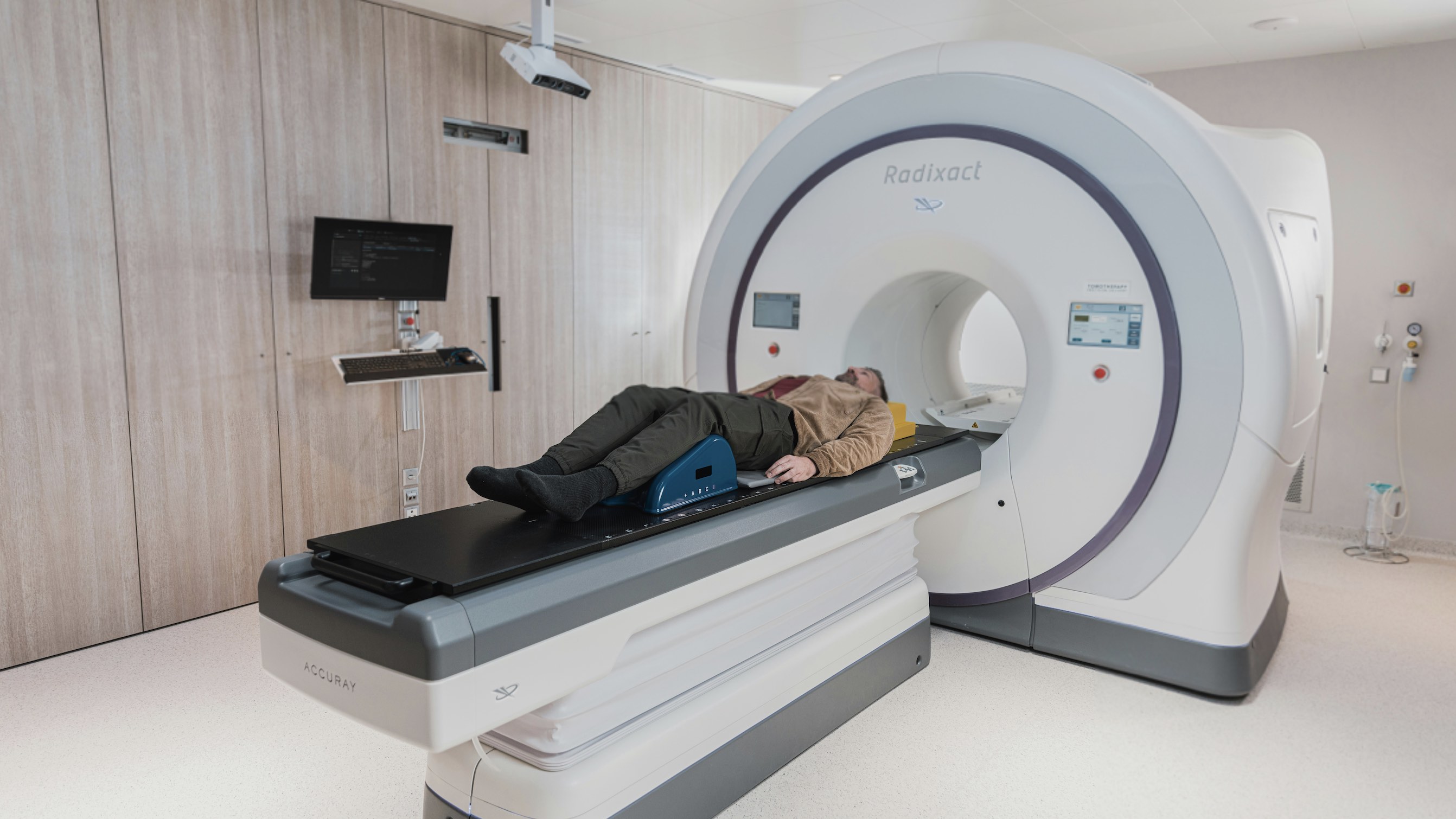
Most people track their weight. Fewer understand their body composition. And almost no one is routinely screened for the hidden risks that sit beneath the surface — visceral fat, declining bone density, or gradual muscle loss that begins years before symptoms appear. In a recent conversation, Thrive physician Dr. Catherine Isaac and health advisor Kelly Joniak explored why DXA body composition scans offer a deeper, more clinically meaningful view of health.
What a DXA Scan Actually Measures
So… what exactly is a DXA scan?
As Kelly explains, “The fancy word for DEXA is dual-energy X-ray absorptiometry. So that’s just telling us that it’s a whole-body X-ray that we’re using to look at three different compartments.”
Those three compartments are bone, fat mass, and fat-free mass.
That last category — fat-free mass — is often thought of as muscle, but it actually includes all lean tissue in the body. The key difference here is that DXA separates bone from everything else. And that matters.
Many people are familiar with bioelectrical impedance (BIA) scales at gyms or at home. Those devices estimate fat and fat-free mass using a small electrical current. They can be helpful for trends, but as Kelly puts it, they’re “reliably unreliable.” They measure only two compartments and don’t give us direct insight into bone density.
DXA adds that third layer — bone — which opens the door to a much more complete picture.
“I almost consider this an essential module… I wish that this was something that would be useful at everyone’s annual primary care visit.” Dr. Isaac notes.
There’s a small amount of radiation involved (comparable to a dental X-ray), so it’s not something you do monthly. But when repeated over time on the same machine, it becomes a powerful way to track real, meaningful change.
And that’s where the conversation starts to get interesting.

Visceral Fat: The Risk You Can’t See
One of the most important things DXA can measure isn’t something you can see in the mirror. It’s visceral adipose tissue (VAT), the fat stored around your internal organs.
As Kelly explains, we don’t want this number to be zero. Visceral fat plays a role in hormone production, organ protection, and energy storage. But beyond a certain point, it becomes a problem. A general rule of thumb discussed in the conversation:
- Less than 3 pounds is considered good
- Less than 1 pound is excellent
- Above 3 pounds raises concern
The challenge is that you can’t accurately assess visceral fat in a typical doctor’s office. Waist circumference and BMI offer clues, but they don’t tell the full story. And that’s where DXA changes the equation.
Dr. Isaac shares how elevated visceral fat on a DXA scan has prompted deeper clinical evaluation:
“I’ve been able to utilize this information to help me do an assessment for fatty liver… and this has been a useful tool to identify some people who’ve never had a diagnosis before.”
Higher levels of visceral fat are strongly associated with increased risk of:
- Insulin resistance and type 2 diabetes
- Cardiovascular disease
- Fatty liver disease
- Even certain cancers
What makes this especially powerful is that someone can appear “healthy” externally and still carry higher-than-expected visceral fat. Without imaging, that risk often goes unnoticed.
The conversation also touches on practical strategies for lowering visceral fat, including reducing alcohol intake, moderating saturated fat, and incorporating high-intensity interval training (HIIT). But the bigger point is this: You can’t change what you don’t measure. DXA doesn’t just give you a body fat percentage, it reveals where fat is stored, and that location matters more than the number on the scale.
Bone Density, Hormones, and What Often Gets Missed
When most people think about body composition, they think about fat and muscle. However, DXA measures something just as important: bone mineral density. And this is where the conversation takes a turn that many people don’t expect.
Kelly explains that bone turnover is slow. It takes months, even years, to meaningfully build bone. Which means waiting until there’s a fracture or a late-stage diagnosis misses a huge window of opportunity.
“We’re definitely being proactive in a way that you don’t normally have the tools to be.” Dr. Isaac also shares
The total-body DXA gives a general T-score and Z-score, which compare your bone density to both young healthy adults and age-matched peers. While it’s not the same as a dedicated osteoporosis scan of the hip and spine, it can serve as an early signal.
In practice, that signal has mattered. For women in perimenopause and menopause, a time when estrogen shifts can accelerate bone loss, DXA can flag early concerns. And sometimes the issue isn’t just hormones. It’s under-fueling.
Dr. Isaac notes that many women respond to midlife weight changes by restricting calories. But without adequate protein and resistance training, that restriction can lead to loss of muscle and bone, compounding the very risk they’re trying to avoid.
The same applies to men. In some cases, lower-than-expected bone density has been one of the first clues pointing toward testosterone deficiency. Without imaging, those subtle shifts may never be detected.
Kelly emphasizes that strength training and proper fueling aren’t just about aesthetics:
“We need to start increasing bone when we’re young and then maintain that throughout our life because it’s really hard… it takes a number of months to years to even grow bone.”
Protein intake, resistance training, plyometrics, vitamin D — these are long-term investments. Not quick fixes. Also, prioritizing bone health doesn’t only mean focusing on fracture prevention decades from now. It also means maintaining independence, mobility, and strength as we age. Muscle and bone aren’t cosmetic assets — they’re functional ones.
Recomposition vs. Weight Loss: Why the Scale Isn’t the Goal
At some point in the episode, the conversation lands on a phrase Kelly hears all the time:
“I just want to lose weight.”
It’s simple. It’s common. And it’s often misguided.
Weight alone doesn’t tell us what’s actually changing in the body. You can lose weight and lose muscle. You can gain weight and improve your health. You can stay the exact same weight and dramatically shift your body composition. That’s where recomposition comes in.
Recomposition means decreasing fat mass while increasing fat-free mass, often at the same time. When that happens, your body fat percentage drops even if the scale doesn’t move much. As Kelly explains, body fat percentage is simply fat mass divided by total body weight. So if muscle increases, even with fat staying the same, that percentage goes down.
And don’t forget that muscle also matters! Functionally, lower-body muscle mass is one of the strongest predictors of long-term independence. Being able to stand up from a chair, climb stairs, prevent falls — these are muscle-dependent skills. Kelly emphasizes that accruing muscle when you’re younger, and maintaining it as you age, changes quality of life later on.
Your “Why” Is the Real Metric
For all the data points, scans, and percent changes discussed, the conversation ends somewhere much simpler.
Why are we doing this in the first place?
For Dr. Isaac, the answer is clear: She wants to be strong and active enough to keep up with her son by running, playing, and not be the one saying, “Wait, I need to stop.”
For Kelly, her motivation is long-term. She looks at her mom and her aunt — women in their 60s and 70s who are still lifting weights, playing pickleball for hours, hiking mountains across the world — and sees what’s possible.
DXA helps make those everyday habits more intentional. It highlights visceral fat before metabolic disease develops. It flags declining bone density before fractures occur. It reframes “weight loss” into preserving muscle and function. The scan itself doesn’t create change. But it makes blind spots visible — and once you can see them, you can act.